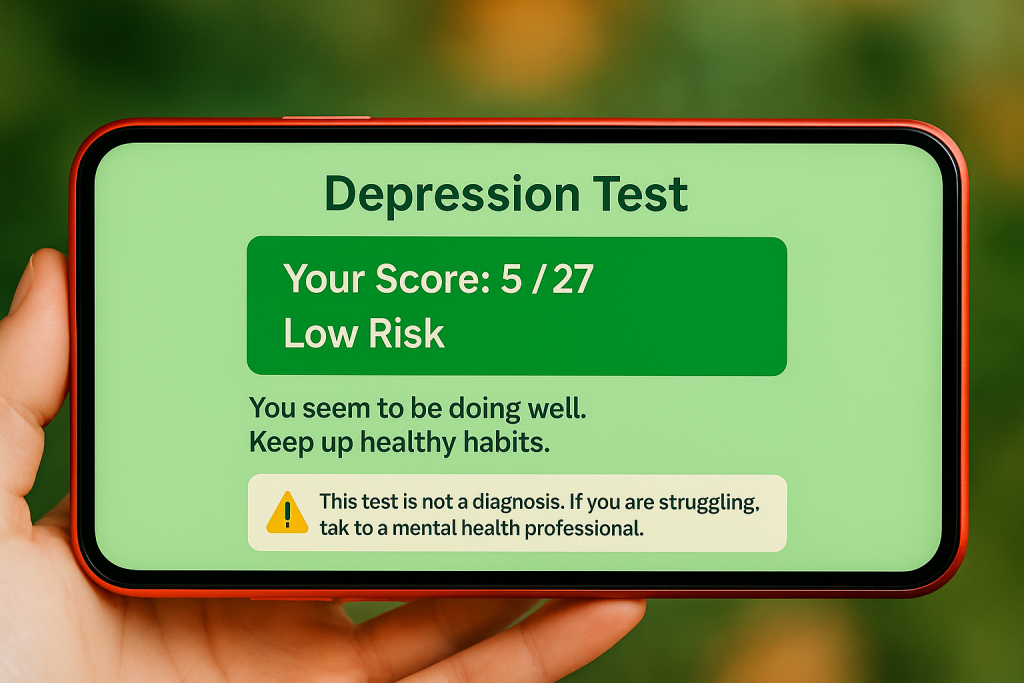
Feeling Overwhelmed?
Do your thoughts feel heavy lately? Maybe you’re exhausted, unfocused, or just not yourself. Mental health affects everything — your ability to think clearly, your energy levels, and the way you connect with the world. That’s why tools like the Depression Test (or self-check screening) are becoming so widely used: in just a few minutes, you can get a quick, science-based snapshot of your mental state.👉 Try taking one of the tests right now — it only takes a few minutes and can help you better understand your state.
In 2025, awareness around depression and mental health is higher than ever. Workplaces, universities, and even governments are investing more into early detection and prevention. While a test isn’t a replacement for a professional diagnosis, it can be a valuable first step to understanding what’s really happening inside.
Why Mental Health Awareness Matters
Life in 2025 is full of pressure — deadlines, screens, notifications, and the constant demand to perform. Stress may quietly shift into anxiety or depression without us even noticing.
The World Health Organization (WHO) estimates that more than 1 in 4 people will experience some form of mental or emotional disorder during their lifetime. The good news? Early detection makes recovery far easier.
Self-check tools, such as online depression tests, give you a private, judgment-free way to pause and reflect: How am I really doing? Think of it as taking your emotional temperature — a fast reading that helps you decide whether you need more rest, support, or professional help.
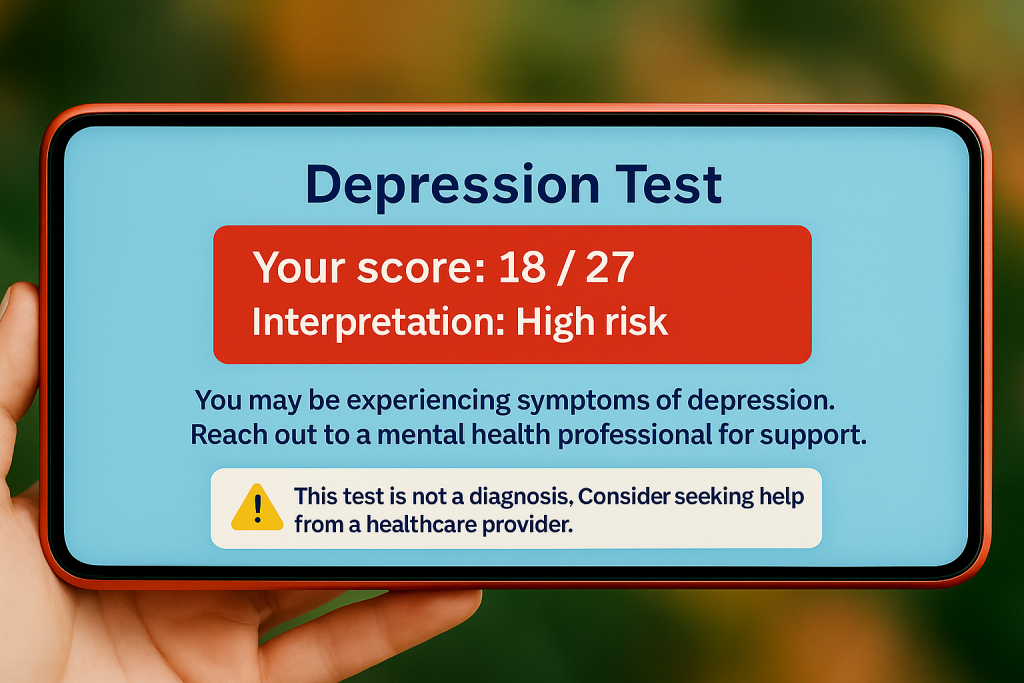
How the Test Works
Most online depression tests are based on clinically validated screening tools, such as:
- PHQ-9 (Patient Health Questionnaire) — the most widely used tool to screen for depression 【https://www.hiv.uw.edu/page/mental-health-screening/phq-9】.
- PHQ-2 — a very short, two-question version for quick checks.
- Beck Depression Inventory (BDI-II) — another well-known self-assessment.
- Hamilton Depression Rating Scale (HDRS) — usually used in clinical interviews.
A typical question might be:
“Over the past two weeks, how often have you felt little interest or pleasure in doing things?”
(Never / Sometimes / Often / Nearly every day)
Your answers are added up and scored. The result gives you a snapshot of your current state, ranging from minimal or mild symptoms to moderate or severe depression.
 Disclaimer
A depression test is not a diagnosis. It’s only a reflection tool to help raise awareness.
If your score suggests moderate to severe symptoms, the best next step is to talk to a licensed professional. A psychologist, psychiatrist, or counselor can provide a full evaluation and recommend treatment.
Example Result
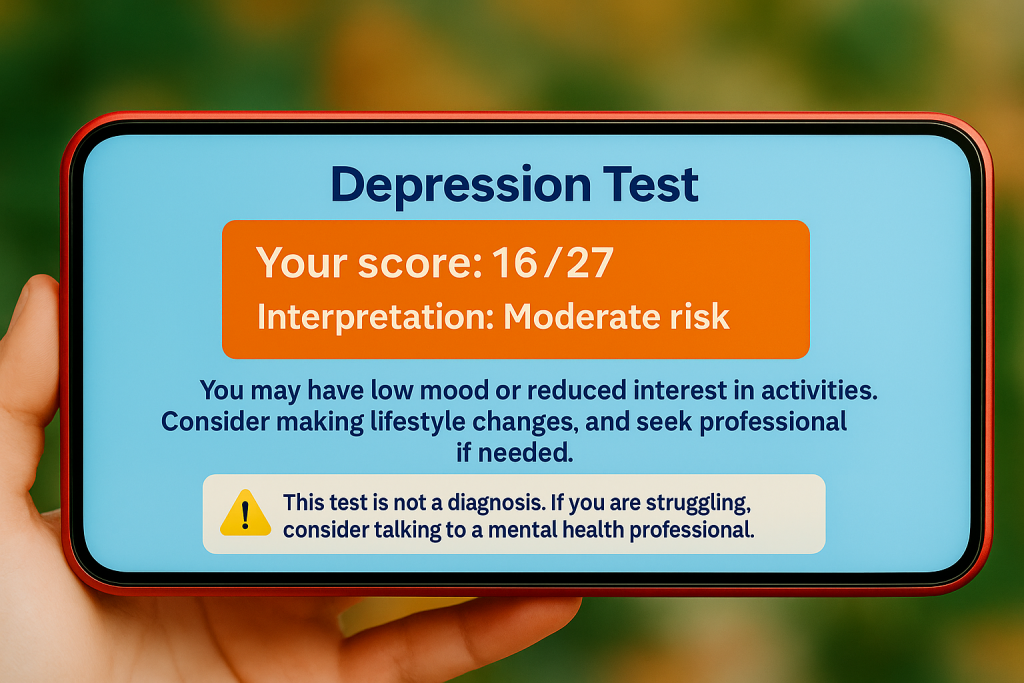
- Your score: 13/27
- Interpretation: Moderate stress and low energy
- What it means: You might feel emotionally drained, unfocused, or disconnected. Lifestyle changes — better sleep, limiting screen time, or daily walks — can help. If symptoms continue or worsen, seek professional guidance.
Why Take It Online?
 Fast & Free — Most tests take less than five minutes.
Private — No signup, completely anonymous.
Helpful — Gain awareness of how stress affects your body and mind.
Empowering — Notice patterns before they turn into bigger problems.
For many, online depression tests are a safe first step, especially if you’re unsure whether you “really need help.”
Taking Care of Your Mind
A test result pointing to stress or mild depression doesn’t mean you’re broken. It means you’re human. Mental health is about balance, not perfection.
Practical steps that help:
- Consistent sleep schedules
- Short digital breaks from phones and social media
- Exercise and fresh air
- Practicing mindfulness or meditation
- Talking openly with trusted friends or professionals
And remember: therapy isn’t weakness — it’s self-care. Just like you’d visit a doctor for a recurring pain, your mental health deserves the same attention.
What’s New in 2025
Recent reports show both challenges and progress:
- According to Gallup, the U.S. depression rate remains historically high in 2025.
- At the same time, a University of Michigan study shows college student mental health improving for the third year in a row, suggesting awareness efforts are paying off.
- Screening technology is evolving: AI-based tools now shorten tests without losing accuracy, and wearables can track sleep and stress signals to give early warnings.
The future of depression assessment is not just about identifying problems, but about empowering people to take preventive steps sooner.
Final Thoughts
Your mental health matters just as much as your physical health. A depression test doesn’t define you — it simply gives you a starting point.
Think of it as a moment of self-check: How am I feeling today?
If your results suggest stress, burnout, or depressive symptoms, take it as a sign to pause, care for yourself, and, if needed, talk to a professional. Depression tests aren’t about judgment — they’re about awareness. And awareness is always the first step toward healing.