Introduction
Spain’s logistics sector is undergoing a rapid but pragmatic transformation as warehouses increasingly deploy Autonomous Mobile Robots (AMRs), automated sorting and picking systems, and AI-driven inventory management. Driven by surging e-commerce, tighter margins, and the need for faster fulfillment cycles, Spanish distribution centers from Madrid to Barcelona now face a pivotal choice: adopt automation at scale or risk falling behind international peers. This article provides an evidence-based review of implementation trends, the operational and economic benefits observed to date, and concrete strategies for workforce transition, emphasizing human-robot collaboration models that preserve productive employment while improving throughput.
1. Implementation Rates and Economic Impact of AMRs in Spanish Warehouses
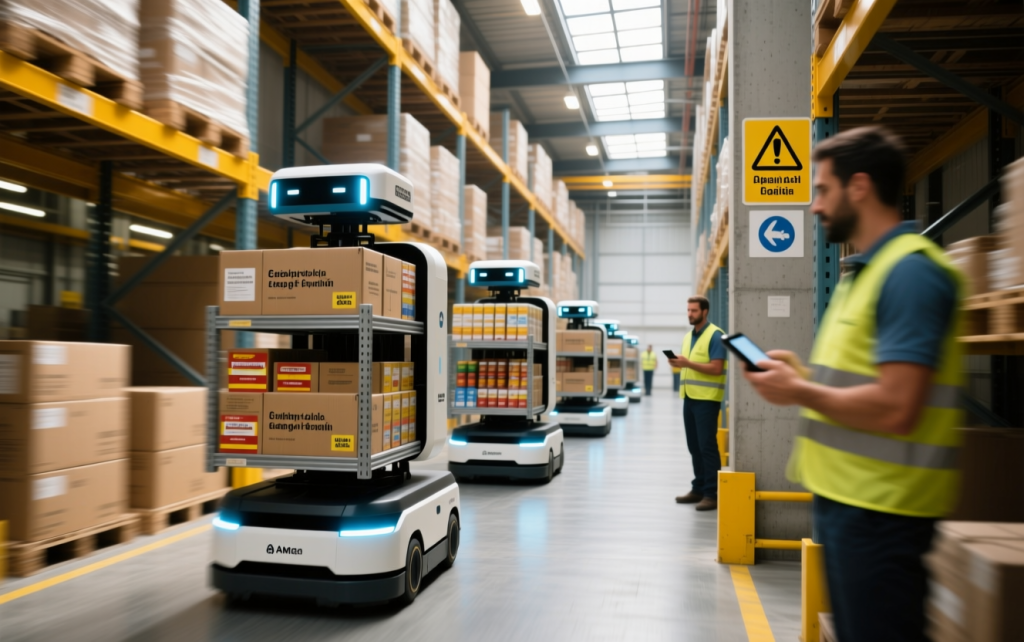
Definition and scope: Autonomous Mobile Robots (AMRs) are flexible, software-driven vehicles capable of navigating a warehouse environment without fixed infrastructure, enabling dynamic routing, shelf transport, and other intralogistics tasks. Adoption in Spain has accelerated over the past three years particularly in large retail, e-commerce and third-party logistics (3PL) hubs concentrated around Madrid and Barcelona.
Current adoption statistics and growth projections:
Industry market research indicates the Spanish warehouse robotics market reached several thousand deployed units by 2024 and is forecast to grow at a double-digit compound annual growth rate through the late 2020s (market analyses project CAGRs in the mid-teens for AMR/warehouse robotics segments). For example, region-specific reports estimate unit shipments rising from roughly 8.7k units in 2024 to more than 23k by 2030 (NextMSC), while global sector forecasts highlight widespread AMR uptake across Europe as logistics operators pursue Robotics-as-a-Service and modular automation strategies (Global Market Insights; ResearchAndMarkets via BusinessWire).
Economic benefits and operational efficiency gains:
Early adopters in Spain report measurable improvements in throughput, picking speed, accuracy and facility utilization. Typical value drivers include:
- Labor-cost optimization: Automated material handling reduces repetitive manual steps (e.g., long walking routes, shelf retrieval), enabling leaner shift staffing for peak windows while redeploying human labor to complex tasks.
- Error reduction and quality gains: AMRs combined with pick-to-light or voice systems reduce picking errors, lowering returns and improving customer satisfaction.
- 24/7 operations and space efficiency: AMRs and mezzanine-integrated workflows allow for denser racking and continuous operations, improving cubic utilization of existing square footage.
Case evidence: Major Spanish retail and e-commerce operators have publicly noted productivity improvements after AMR integration. Amazon’s fulfillment centers in Spain incorporate extensive automation (including Amazon Robotics technologies) to increase throughput during peak seasons (Amazon Robotics / Amazon Fulfillment). Vendors and systems integrators report ROI timelines for AMR fleets in the 12–36 month range depending on labor cost structures and operational complexity (Global Market Insights).
2. AI-Driven Inventory Management: Transforming Traditional Warehouse Roles
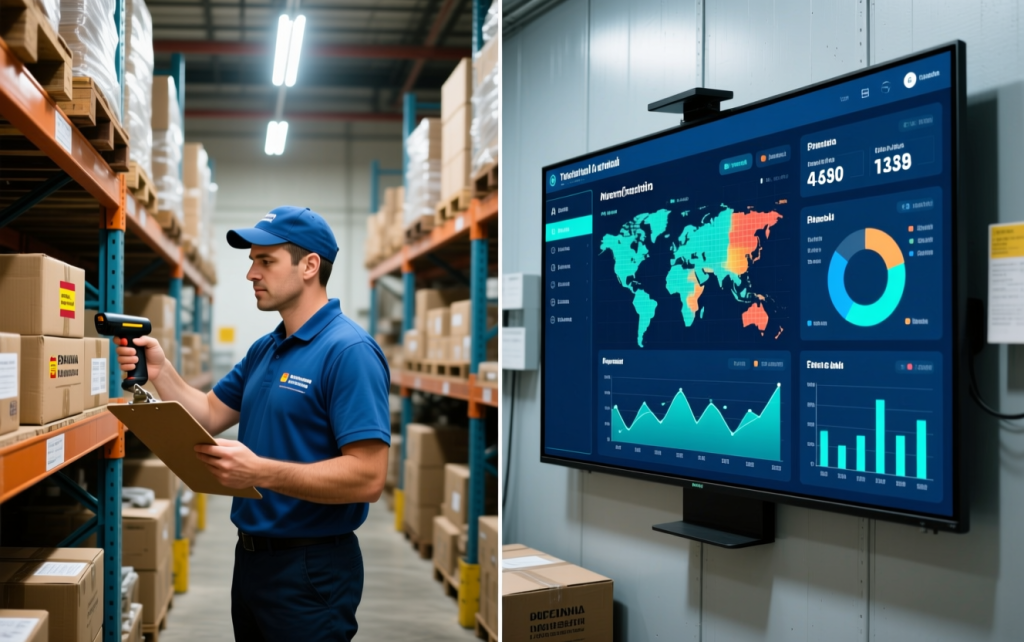
Real-time inventory tracking and predictive analytics capabilities:
Contemporary warehouse management systems (WMS) augmented with AI provide continuous inventory visibility, demand forecasting and optimized replenishment schedules. These capabilities materially reduce stockouts and overstocks, particularly in fast-moving retail categories. In Spain, sectors with strict inventory demands—such as pharmaceuticals and automotive parts—have been early beneficiaries of AI-enabled inventory controls; manufacturers and distributors report higher fill rates and lower safety stock requirements after system upgrades (Eurostat sector analyses; specialized market reports).
Evolution of warehouse staff roles from manual to analytical:
The staff profile in a modern automated warehouse shifts from predominantly manual pick-and-pack roles to a balanced mix that includes system operators, data analysts, AMR fleet technicians and process improvement specialists. Key role transitions include:
- From manual pickers to system supervisors who manage exception handling, quality control and rapid problem resolution.
- New analytical roles responsible for interpreting WMS dashboards, adjusting replenishment algorithms, and tuning demand-forecast models.
- Technical maintenance roles for robotics servicing, battery management, and software updates.
Training and upskilling: Employers are increasingly investing in structured training pathways—often in partnership with technology vendors and vocational institutions—to transition incumbent workers. Examples include on-site vendor certification programs and short professional courses in robotics maintenance and data literacy (see robotics vendors and local training initiatives such as ABB’s industry outreach in Madrid: ABB).
3. Human-Robot Collaboration Models: New Workforce Structures
Cooperative workflow models between humans and robots:
Rather than full replacement, many Spanish warehouses adopt cooperative models where robots perform repetitive, non-value-added movement and humans perform complex decision-making and exception tasks. Typical collaborative models include:
- Pick-and-transport: AMRs autonomously deliver racks or tote stations to human pickers who perform the final selection and quality checks.
- Shared-space operations: Humans and AMRs operate in the same aisles with safety-rated sensors and coordinated traffic management ensuring safe interaction.
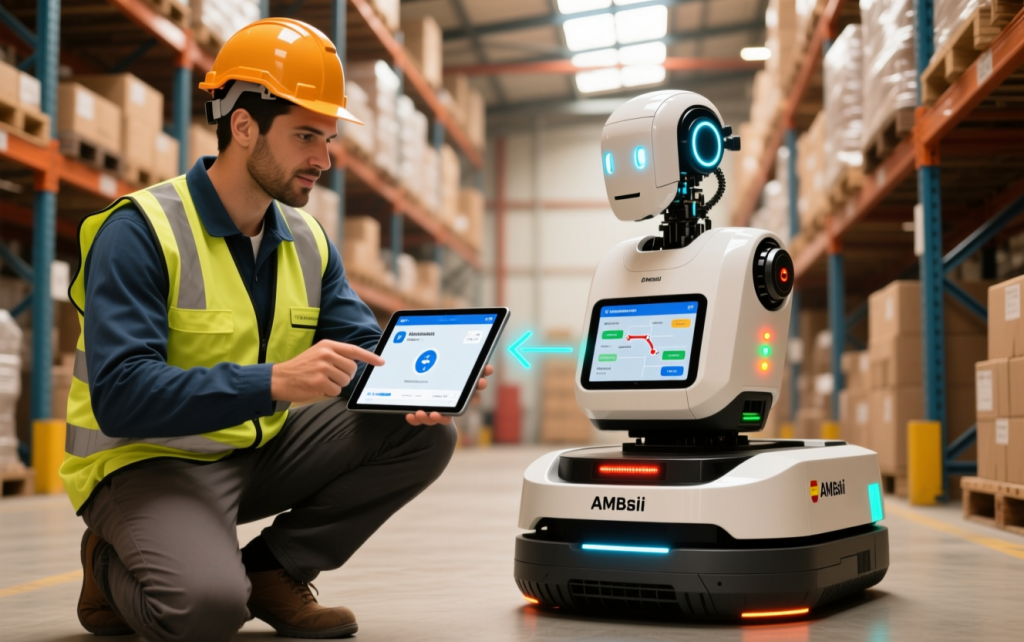
- Supervisory control: Human operators use tablets or control stations to adjust robot tasks, reroute fleets and manage priority orders.
Organizational changes and team restructuring:
Integrating robots requires evolution in reporting structures and cross-functional teams. Notable organizational changes include:
- Creation of mixed operations teams where technicians, process analysts and floor supervisors report into a single fulfillment operations manager.
- Introduction of “robot supervisors” responsible for fleet health, coordination with WMS, and liaison with IT departments.
- Cross-training programs that rotate employees through robotics maintenance, inventory analytics, and quality assurance to create resilient workforce pools.
Impact on workplace culture and employee satisfaction: Surveys from automated facilities indicate mixed outcomes—while repetitive, physically demanding tasks decline (improving ergonomics), staff sometimes report anxiety over skill gaps. Effective change management—transparent communication, visible retraining pathways, and participation in technology rollout—correlates with higher acceptance and retention.
4. Job Displacement vs. Creation: The Spanish Warehouse Employment Landscape
Quantitative analysis of jobs displaced by automation:
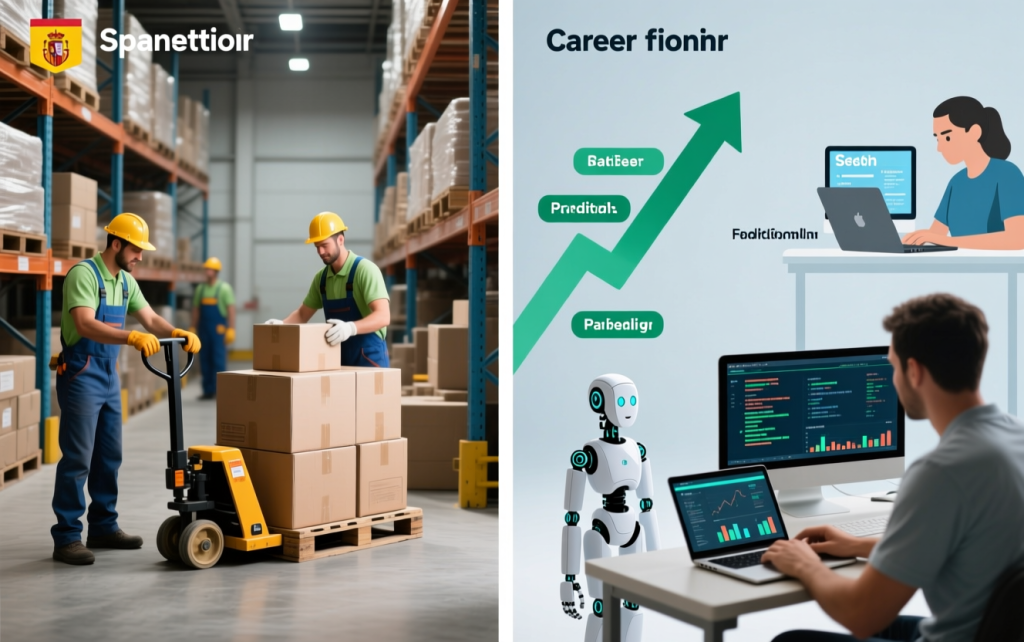
Automation inevitably reduces demand for certain manual roles (e.g., long-haul pickers, manual sorters) but the net effect on employment depends on scale, timing and complementary investments in new activities. Market studies projecting AMR and robotics growth indicate only a portion of manual roles are fully replaced; many are reclassified into supervisory, technical and analytical positions. Regional impacts vary—high-density logistics clusters may see net job transformation, while smaller local facilities could consolidate functions and reduce headcount (NextMSC; Robot Magazine).
Emerging roles and skill requirements in automated facilities:
Common newly created positions include:
- AMR technician/maintenance engineer: electrical/mechatronic skills for routine maintenance and fault diagnosis.
- Automation systems analyst: WMS and data analytics specialist who tunes forecasting models and operational KPIs.
- Integration specialist: software and middleware expert who ensures robots, conveyors and WMS communicate reliably.
- Continuous improvement lead: process engineer focused on lean workflows and hybrid human-robot task design.
Training and upskilling programs in Spain: Public-private training initiatives, vocational centers (Formación Profesional), and vendor-led certification courses are expanding to meet demand. Companies such as ABB and major systems integrators often run local workshops; larger 3PLs and retailers build internal academies to reskill staff. These programs typically emphasize practical competencies (robot troubleshooting, basic PLC and network knowledge, and data dashboard interpretation).
Strategic Recommendations for Warehouse Managers and HR Leaders
To navigate automation while preserving workforce resilience, logistics leaders should follow a phased, people-centered strategy:
- Conduct granular role mapping: identify which tasks are automatable and which require human judgment, then create transition pathways.
- Invest in modular automation: start with pilot AMR deployments in discrete zones to measure productivity and workforce impacts before scaling.
- Design clear upskilling ladders: commit to retraining guarantees (e.g., hours of paid training, certification sponsorship) tied to role transitions.
- Create hybrid teams: embed technicians and analysts within operational squads to accelerate learning and foster ownership.
- Engage social partners early: consult labor unions and local government bodies to design equitable transition programs and leverage public training funds.
Practical Implementation Checklist
For operations planning, use the following checklist to align technology, people and processes:
- Evaluate current KPIs, peak load profiles and SKU characteristics to identify suitable AMR tasks.
- Select AMR vendors offering open APIs and integration support with your WMS/ERP.
- Plan physical changes (charging stations, traffic lanes) and safety reviews before deployment.
- Map competence gaps and procure tailored training from vendors or vocational providers.
- Measure performance across productivity, quality, and employee engagement; iterate on change management elements.
Conclusion
Automation in Spanish warehouses is not simply a question of replacement; it is a systemic transformation that redefines the nature of warehouse work. AMRs and AI-driven inventory systems deliver measurable operational benefits—higher throughput, lower error rates and more efficient space utilization—while also creating demand for technical and analytical roles. The core challenge for Spanish logistics operators is to manage this transition consciously: couple technology investments with robust retraining programs, phased deployments and collaborative workforce models that emphasize human supervision, problem-solving and continuous improvement.
When implemented with foresight, automation becomes an amplifier of human capabilities rather than a net eliminator of employment: workers move up the value chain to roles that require judgment, technical know-how and process design. Warehouse managers, HR leaders and policymakers should therefore prioritize integrated strategies—pilots, vendor partnerships, vocational training, and social dialogue—to ensure Spain’s warehouses remain competitive, resilient and inclusive during the robotic revolution.